
Extra Credit Assignment: Episode 1 of “The 1619 Project”

Mackenzie Wiater

For my extra credit assignment, I watched the first episode, “Democracy”, of  The 1619 Project on Hulu. This show is about the history of how black Americans have been treated by their fellow Americans. This episode takes place in multiple different parts of America, including Iowa, Georgia, Virginia, and New York. A woman named Nikole Hannah grew up with a great father, Milton Hannah. Milton Hannah proudly displayed his patriotism for his country because he had served in the army at 17 years old. He showed his patriotism even though America had not treated him and his ancestors well. Nikole first brought the viewers to Atlanta, Georgia to show the issues with voting. A woman named Helen Butler was working in civic engagement work to protect the people’s right to vote and increase engagement in voting. Her job is to also help out with errors in polling, and decrease voting fraud. Then the viewers are brought to Williamsburg, Virginia. The Governor’s palace was a big part of this part of the episode. They talk about a lot of the history during the time of slavery that occurred between enslaved people and colonists. The Governor of Virginia would threaten the colonists by telling them he would free the slaves to stop them from revolting and scare them away. His threat then became reality, and those who agreed to help fight the colonists would get freed. The Southerners were angered by the Governor’s (Dunmore) Emancipation Proclamation. 

American slavery began in 1619, hence why it is called “The 1619 Project.” Those interviewed in the episode explained that it feels like they were taught in schools as if it was only a white America. For example, slavery was happening before the Mayflower even sailed, yet no one is really taught that in all schools. The 1619 project got a lot of backlash. Many states tried to get it passed that the 1619 project could not be taught in schools. One state even wanted teachers to wear body cams so they could monitor what they were teaching to make sure this was not being taught. Trump also said in a speech that he believed the 1619 project was “toxic propaganda.” The episode then moved on to Brooklyn, New York. Brooklyn’s Plymouth church was a safe haven for those escaping slavery, and was also called the Grand Depot of the Underground Railroad. This part of the episode showed how black Americans stood up for themselves and refused to leave America, because they were just as American as white people. This is the part of the episode that reminded me of the book A Raisin in the Sun. White people discriminated against black people just like how they did in the book/play. The episode in The 1619 Project showed how black people got in trouble for fighting for equality, and equality is something all the characters wanted in A Raisin in the Sun.
Extra Credit Assignment: Myriam Gurba at SUNY Cortland

Mackenzie Wiater

The event I chose to watch for extra credit was the video of Myriam Gurba coming to speak to Cortland. This was a really interesting video to watch. She spoke about a lot of things that we discuss in class. It started off as an introduction from Professor Savonick talking about who Myriam Gurba is and what was going to be done during the zoom meeting. Then the viewers got to hear from Gurba herself. Gurba also introduced herself a little and then read the chapter from Mean that was about the fifth grade race war. After reading this chapter, she then moved on to reading a little bit of an essay that she had in progress, which was an experimental essay. This was an interpersonal essay about her and her cousin growing up with a “backpack full of skeletons.” This backpack of skeletons was all of the trauma that Gurba and her cousin have had to carry around with them throughout their lives. 

After reading her chapter, the meeting then turned to open discussions where people asked questions. The first question asked was, “What was the process like for writing Mean, and how long did it take to complete it?” I found it really interesting that Gurba explained that this piece of work was a fragmented process, and she began to write about six or seven years before the memoir was even published. She did not intend for these experimental fragmentations to be published. Her first intentions were to write about sexual assault using humor because she had never seen that before. She also talked about how she narrated the sexual assaults in her book like a butterfly watching it happen. This is something that we discussed in class. We talked about how it seemed like Gurba was writing it from a bird’s eye view, and that is exactly what Gurba told us her intentions were. She said she wanted it to be told from a third eye witness, and for readers to “watch the event unfold from the imaginative perspective of the environment.” 

Another question that was asked was “Has it become easier to reflect and talk about Mean as you get older, and what is it like to have people analyze and ask questions about such private moments in your life?” This was a great question to ask because it is also something we discussed in class. Gurba expressed how her answer to this question is a little complicated. In some instances, her experiences have become easier to discuss. When she was between the ages of 19-21, she barely spoke about her experiences because they were so recent, and maybe not yet fully processed. However, certain experiences can be easier to talk about now that she is about 20 years older. These events were so horrifying that they will most likely remain difficult to talk about forever for her. For example, she was sexually assaulted by a murderer. She expressed that this is just something she will never recover from and she will always carry with her. To this day she does not like to be tapped on the shoulder or startled from behind because of what she has gone through. Gurba also expressed that writing Mean was not a healing experience because things are so difficult to talk about, but it was somewhat comforting to write. Gurba shared that this was a comforting experience because she was experiencing domestic violence while writing her memoir. Even though it was not a healing experience, it was kind of a comforting experience because her significant other could not control her manuscript like he was controlling her life.

Many more great questions were asked during this zoom call. I really appreciated hearing from Gurba and appreciated how she shared more than just what she told us in her memoir. She shared very vulnerable experiences with her viewers, and I really respect that.

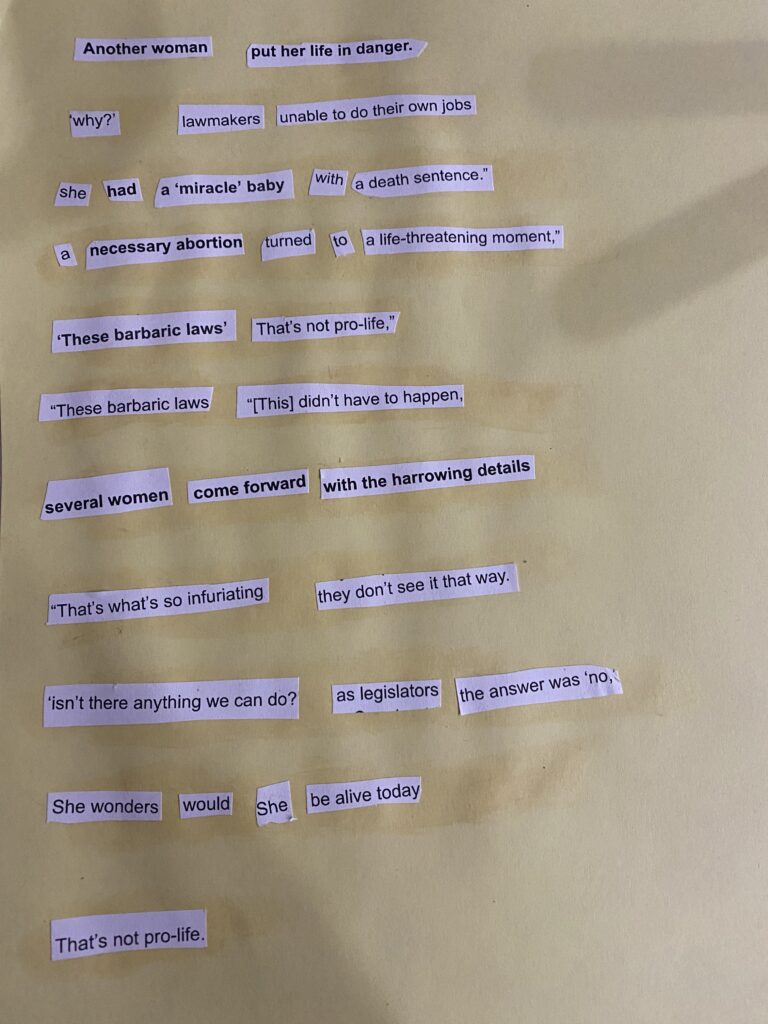
Women vs. These Barbaric Laws

To create my found poem, I decided to use an article on an unfair decision regarding someone needing an abortion. This article was based on a woman who almost died because the Texas laws made it so that she could not terminate her pregnancy until it was life threatening to her, even though her baby was dying inside her. As a woman, this is a very important topic to me. I knew I wanted to create a poem that illustrated how certain laws can really affect a woman. I decided to first read the article without looking for words to cut out. Then, I read it a second time and highlighted the words and phrases that stood out to me on a google document. On my printed out copy of my article, I cut out all of the words and phrases that I had highlighted. Once everything was cut out, spreading everything out randomly really helped me start my found poem. I knew I wanted to emphasize the effects abortion laws have on women, and seeing the different phrases next to other random phrases really helped me do that.

I am very happy with the way my poem came out. This experience helped me understand why Philip decided to create Zong! in this format much more. The short little phrases I used definitely created a more dramatic effect to emphasize the important meaning behind my poem. I wanted to represent women’s rights and respect their right to live. Those were also Philip’s intentions when writing Zong!. These Africans’ rights and lives were taken away from them. The woman who I am referring to in my poem almost had her life taken from her because her right to terminate her pregnancy when it was very much needed was taken from her.

“They Shall Rise Again”: Remembering Those Lost at Sea in Zong!

In Zong!, M. NourbeSe Philip brings awareness to the lives once lost on a ship with the use of a unique style of writing. In 1781, a ship called the Zong set sail from Africa to Jamaica. This insured ship carried 470 slaves. The Zong’s captain, Luke Collingwood, is responsible for the tragic death of many of these slaves. These slaves were thrown overboard from the ship in order for the owners to get more money from insurance. Due to insurance disagreements, this case was taken to court. This case inspired Philip to write her poems to remember the tragic loss of these Africans. In the beginning of the text, Philip includes a quote written by Dylan Thomas that says, “Though they sink through the sea they shall rise again.” This quote is a great representation of the meaning behind Philips’ poems. Although these lives were tragically lost in the sea, they shall be remembered. Philip spreads awareness of these deaths through her poetry. She started out by researching all about the history of the ship and its court case. Philip began writing down information from the court case, and would take out some words and phrases while leaving the rest of what was written. Philip writes, “I murder the text, literally cut it into pieces, castrating verbs, suffocating adjectives, murdering nouns, throwing articles, prepositions, conjunctions overboard, jettisoning adverbs: I separate subject from verb, verb from object–create semantic mayhem, until my hands bloodied, from so much killing and cutting, reach into the stinking, eviscerated innards, and like some seer, sangoma, or prophet who, having sacrificed an animal for signs and portents of new life, or simply life, reads the untold story that tells itself by not telling” (193-194). The use of the word murder compares what she does to the text to what the Captain of Zong did to the slaves. She rips away all of the different parts of certain words, just like how so many Africans’ lives were ripped away from them. Philip throws conjunctions overboard, exactly like they threw all of the slaves overboard. She brings awareness to the horrors the slaves faced by just putting it into a different context.

This separation that Philip refers to causes there to be words and phrases randomly placed on each page. At first, this seems very confusing. There seems to be no meaning behind the words Philip has written down. However, that was exactly her intention while writing these poems. Philip explains, “When I start spacing out the words, there is something happening in the eye tracking the words across the page, working to pull the page and larger “meaning” together– the eye trying to order what cannot be ordered, trying to “make sense” of something, which is what it must have been like trying to understand what was happening on board the Zong–meantime there are smaller individual poems to be found in different places on the page as the lines are juxtaposed and work together” (192). Philip spaced out the words in her poems to have an emotional effect on readers. She is bringing awareness to how the people on the ship must have felt as those around them were being thrown overboard and killed for no good reason. As you read the random consonants, vowels, words, or phrases on the page in each poem, it is difficult to make sense of what Philip means. At first her intentions were very unclear to me. That is how it must have felt as an African on the ship. They were taken from their homeland against their own will just to be thrown overboard. Those Africans could never make sense of what was done to them. Philip illustrates that same effect by writing poems that do not make sense grammatically or logically. 

Even though Philip’s intentions are to bring awareness to the Zong tragedy, one will never be able to fully make sense of it all. There are many times throughout the Notanda section of the text where Philip repeats that this is not a story to be told. One example of this is Philip writing, “And only in not-telling can the story be told; only in the space where it’s not told – literally in the margins of the text, a sort of negative space, a space not so much of non-meaning as anti-meaning” (201). This quote is another great representation of why Philip uses this style of writing to bring awareness to the Zong tragedy. By cutting out different words from the text, it creates a lot of blank space on the page. This space represents the negativity and horror that is unspeakable. There are no words to explain the devastation of these deaths. These spaces also represent the unknown names of these Africans. Although unknown and sunken into the sea, these lives lost shall be recognized and rise again. 

Discussion Questions: 

  1. What was your interpretation of the repetition of Philip saying this is not a story to be told, but one that will tell itself?
  2. Was Philip’s style of writing an effective technique to illustrate the raw emotions of the Zong tragedy? 

Work Cited

Philip, NourbeSe M. Zong!. Middletown, Connecticut, Wesleyan University Press, 2008.

Hi, I’m Mackenzie!

My name is Mackenzie Wiater, and I am from New Hartford, NY. I am a Junior majoring in speech and hearing science, and plan on becoming a speech language pathologist someday. One thing about myself is that I love being outdoors, so I am looking forward to this Spring semester for when the weather starts to get nice out again. I am also someone who loves to get to know new people, so I am glad to be taking a class like this where I have a good opportunity to meet new people!

css.php Skip to content