
Myriam Gurba Review: Nature of the Memoir Mean(Kenari Curry)

Myriam Gurba spoke about the background, production process, and other subtleties of her book, “Mean” at a Cortland event held in 2021. Throughout the discussions, she brought up some extremely intriguing facts and observations regarding her experience. Being mea, as our Professor says, “makes us feel alive, it’s fun and exciting, and sometimes it keeps us alive.” Putting into words the feelings and messages that may be gleaned from this book. The first highlight she mentioned was when she read an extract about a racial conflict that erupted on the playground while she was in fifth grade, resulting in self-segregation. In reaction, she discusses how she formed a gang/micro family to protect themselves from aggression, and how they badly wanted to escape institutions and organizations that abused them. This simply goes to show how serious it is for children to behave and respond to events and/or other people, and what it may lead someone to do, as well as the impact on the community. As an answer to a student, she also discusses her writing process for the book. She surmised that writing the novel was a jumbled process in which she wanted to include both comedy and terror, which led to her constantly attempting to get the desired style. This is further illustrated when she discusses how she intended to express her unsettling experiences from the imagined perspective of the surroundings, giving the account of what occurred a witnessing and outside party sense that is too horrible to recover from. 

The highlights also show several parallels between Gurba’s book and Maxine Hong Kingston’s renowned work, “Woman Warrior.” The first is how both “Mean” and “Woman Warrior” delve into the complex issues of race, discrimination, sexuality, and sexual assault, with both authors emphasizing the importance of speaking up and owning one’s narrative as a means of empowerment and self-discovery, as well as confronting the silence that surrounds these experiences unapologetically in the hope of breaking free from societal constraints to reclaim their voices. The second link is how Gurba’s “Mean” and Kingston’s “Woman Warrior” both explore the quest for belonging. Gurba, as a gay mixed-race woman, faces the difficulties of managing many identities, as well as the sensation of dislocation that frequently comes with it. Similarly, Kingston’s protagonist struggles to find her place amid two divergent cultures. Both writers are able to shed light on the inner upheaval and self-exploration involved in the search for acceptance and a sense of belonging. In conclusion, the event provided more insight into the mind behind the book Mean, going over her creation process and detailing how the book made her feel and what meaning should come from it, as well as the message it’s attempting to convey, which I believe is best summarized when our Professor again provided a general message behind the book’s purpose. That is, you should utilize your position and privilege to help others who have been harmed or wronged in life.
The 1619 Project: Limitations of Democracy and Citizenship(Kenari Curry):

The Hulu documentary series, The 1619 Project focuses on the tremendous influence of slavery on the establishment and growth of the United States. The first episode, in particular delves into the complicated link between democracy and Black citizenship throughout American history, connecting with Claudia Rankine’s book “Citizen.” This specific episode serves as a sobering reminder of Black people’s difficulties and tenacity in their pursuit of full citizenship rights. It powerfully illustrates how institutional racism, marginalization, and violence have frequently stained the promise of democracy. The episode demonstrates how Black people have battled relentlessly to resist oppressive systems that deny them equitable participation and acknowledgment in American society via historical narratives and personal testimonies. In terms of parallels with Claudia Rankine’s “Citizen’s, which is a thorough exploration of race, identity, and belonging in contemporary America. It delves into the lives of Black people and the ways in which racism presents itself in everyday interactions, both explicitly and subtly. 

Also paralleling the “Democracy” episode, “Citizen” emphasizes the struggles faced by Black citizens in a supposedly democratic nation. One striking connection between the two works is the recurring theme of the erasure of Black voices and experiences. In the 1619 Project, this erasure is exemplified by the historical omissions and distortions that have perpetuated the myth of a harmonious democratic past. Similarly, Rankine’s “Citizen” highlights the microaggressions and acts of erasure experienced by Black individuals in their everyday lives, further underscoring the ongoing struggle for true recognition and equal treatment. Another connection is the confrontation between the issue of racial violence and its impact on Black communities. Highlighting the difficulties experienced by Black people in an ostensibly democratic country. These constant issues to erase Black voices and experiences is a strong connection between the two works. This erasure is represented in the 1619 Project by historical omissions and distortions that have fostered the idea of a peaceful democratic past. Similarly, Rankine’s “Citizen” underscores the microaggressions and acts of erasure that Black people face in their daily lives, emphasizing the constant battle for full acknowledgment and equitable treatment. Another link is the fight over racial violence and its impact on Black communities. Exposing how the psychological and emotional abuse imposed by racially motivated violence has a negative effect on the group as whole, similarly to Citizen in highlighting the need for healing and societal transformation. Exposing how racial violence has been used as a tactic to repress non-white groups political power and freedom. In conclusion the first episode of the 1619 Project focused light on Black Americans’ struggles in America’s pursuit of democracy. Examining the historical and contemporary problems that Black people have experienced in their pursuit of equal acknowledgment, representation, and justice.

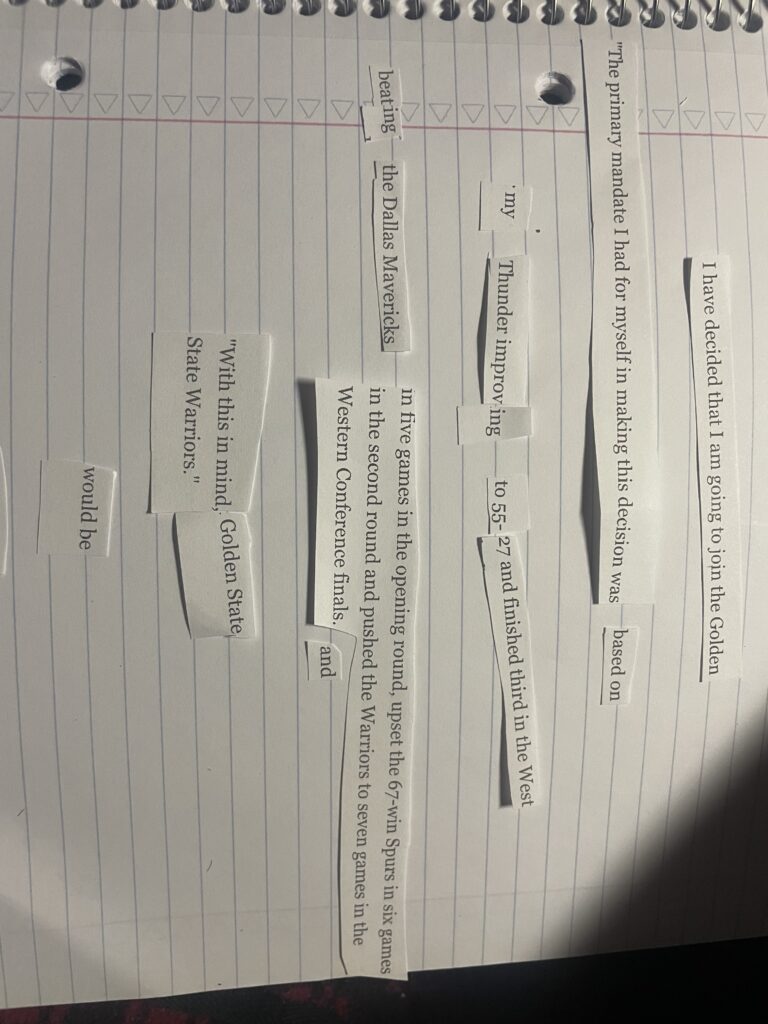
Kevin Durant to Golden State

The method I used for creating the poem was a simple cut and paste method where I found words or sentences that I felt would make a new poem flow and would get the general meaning across. I looked for simple yet clear statements that allow the reader to mentally see what the words say and can understand and placed them on the page like the title crawl in a Star Wars movie. Using the effect of eye tracking to allow it to flow down.

When working on the poem I just felt a similar feeling I felt that day when it happened. I just reminded me why I was pretty upset about it and just reminded me that memories can actually invoke feelings. From working on this I got a sense of what Zong! was trying to do and place what seem like separate words into a connected story that describes and invokes feelings through memories whether that be felt through first, second, or third person.

The Impact of Blood: How Tradition effects Lifestyle

The symbology of blood has many representations throughout different cultures. Some have literal views, and others have figurative, but one view that is shared throughout most cultures is the mixed view that your blood is the essence of everyone that came before you and that blood is to be honored by following the way of life your predecessors did. This way of life can be called Tradition or can be called a culture itself, and one of the greatest “sins” that can be thought to be committed by cultures is the dishonoring or disgracing of one’s blood, or in other words dishonoring one’s way of life that is shared through those that share blood. This belief has had lasting effects and influence on history and how people are treated harshly within their own culture, and a prime example is the effect it had on Maxine Hong Kingston and her aunt as told in the first reading of The Woman Warrior: No Name Woman.

Depending on the culture one resides in, it can determine the magnitude of how tradition or a following the shared life is treated. This will affect the rewards and punishments given when the way of life is not followed. China is an example where tradition is one of the profound things about their culture. This can be thought of as a result of the clan system that was practiced through ancient times and carried its influence even into the present. In a general sense clan were similar to tribes, they were families that were tied to an ancestral village who practiced and shared the same ideals. If one strayed from these things, they were seen as not part of the clan or in other words “family” and could be punished for it. This is because when dishonors their own way of life it is life, they are dishonoring everyone else’s way of life, including those who have died. I believe this is the reason why when I heard the story of her aunt, it was so graphic and disheartening. The way the people acted was possibly a result of feeling that she dishonored the way of life that has been practiced for a very long time, although it’s not nearly as tightknit and strict as it was centuries prior. But religious ties have persisted, and it seems like the smearing of blood by animals and just the use of them in general is a very common practice throughout many cultures. They even essentially stoned her house which can be a common practice of traditional punishment as well.

The way they reacted seemed like they had done it before and was a common thing that is a part of their tradition. It was a very harsh reaction, to impose on anyone and would traumatize most, especially after having to give birth in the pigsty as a result. It was so traumatizing in fact that it led to her suicide. Then also led to a young girl hearing that story once she first started menstruating and told not to humiliate the family as her aunt did. The harsh effects of tradition seem to keep passing down which only cause harsh reactions as a result. Having to keep up to tradition can have a profound effect on anyone, especially children, it’s like how Kingston states, “The villagers are watchful”(9), kind of like ghosts who haunt you to make sure you don’t dishonor the tradition that has been kept for so long, and everyone knows that people have been led to crazy things because of being haunted, so having to keep up tradition can do the same. Like the tradition of decapitation in old Japanese war culture, or the tradition of witch-hunting in old European culture, or the tradition of persecution throughout world culture. A cycle of tradition that should be kept can be harmful, but there are traditional practices that are beneficial, it’s not all bad. Kingston stated that, “Whenever she had to warn us about life, my mother told stories that ran like this one, a story to grow up on”(10). Instead of hearing tragic stories like this one, there could be stories told meant to inspire one to grow up, not frighten one. Which leads into the questions below:

  1. Do you believe there was possible potential benefit to Kingston’s mother telling her that story of her Aunt?
  2. How impactful do you think tradition is on today’s society?

Kenari

Hello, my name is Kenari Curry and I’m from Syracuse Ny. I am an exercise science major looking to go into physical therapy or athletic training. I like watching sports and comedies as well as napping.

css.php Skip to content