
Extra Credit Opportunity

I decided to watch the Myriam Gurba event. This event took place on May 4th, 2021 over a zoom call. This event had Myriam Gurba herself come on the zoom call to talk about her most popular book, Mean. During this zoom call Professor Savonick started off with an opening speech that included saying her gratitude for everyone who helped with the event, introducing Gurba, and giving a brief summary of Gurba’s book Mean. Gurba started off her time by thanking everyone and explaining who she is again. In the first half of the event Gurba read the chapter “GooglePlex”  from Mean. After she finished the chapter, Gurba was explaining that next she was going to read some words from her essay that’s a work in progress. This was very interesting to hear because one, it was one of Gurba’s works in progress which means it’s her raw writing (such as her rough draft) and two because it was a new writing from her that I’ve never heard before. After the readings the audience started to ask questions which began some conversations which were directed towards either Gurba herself or the book.

When listening and watching the zoom call I was very excited to see how she reads her own book and her own words. While she was reading I realized that she read it differently than how I have been reading it. This caused a lot more interest in listening to her read because it was the author herself reading the book that you just read in class. While Gurba is reading her chapter, she still has that snarkiness and passive aggressive tone while she’s talking like she does when you read her statements in the book. Hearing her work in progress essay, her writing tones and strategies sounded the same as if you were reading the book Mean. From class we read a transcript of an interview with Gurba, Gurba explains that she likes the “short and directed titles” but with her work in progress the essay that she read had a very long title to it. Is there a reason why she chose a long title?

 In her essay Gurba explains that she had a club when she was 12 or 13 years old but called it a “gang” and they all had gang member names for each other. In class we explained that Gurba possibly grew up too fast. Gurba is at a very young age and calling her club a “gang” shows that she has had a mindset like an adult for most of her childhood. As well as youthful innocence was brought up in the event.

This event was very enjoyable to watch/listen to especially when the reader herself is there to answer questions and read directly from her book. I learned many little things about the book such as it took 6 or 7 years from start to finish to complete the book, she wanted to bring horror into the book and not just humor, and the book itself was a lot of experimental fragments. All of the questions asked during the event were very good and enjoyable as well.              
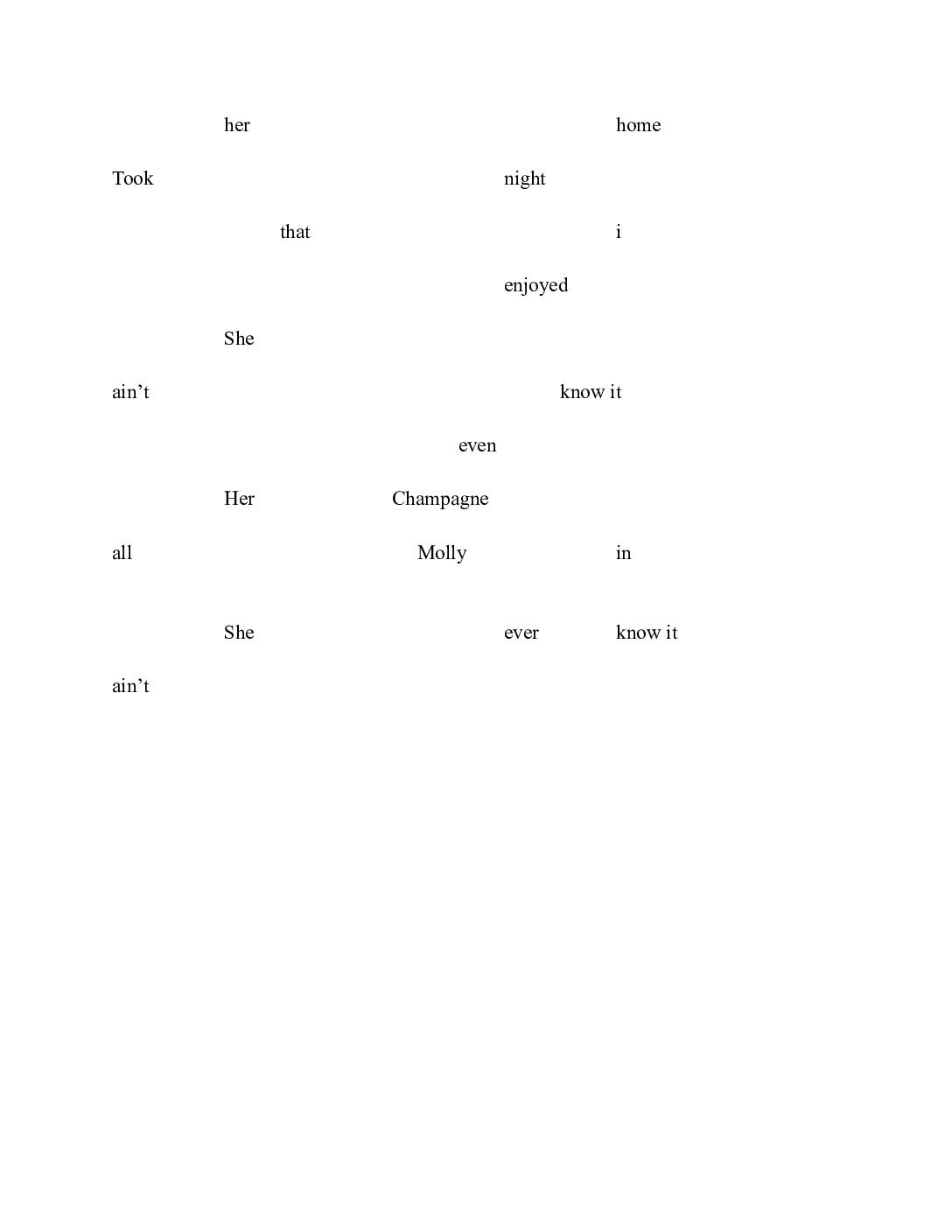
Molly’s Champagne


“Molly’s Champagne” is a poem based off of the song lyric, “Put Molly all in her champagne, she ain’t even know it / took her home and I enjoyed that, she ain’t even know it” from the song She Doesn’t Even Know it written by Rick Ross. I went along with this poem by interpreting that “molly” and “champagne” are the two bug key words. I decided to put those in the middle to grab the attention of the readers. I was inspired by Phillip’s strategy of how she replaces one word from a sentence and it changes the whole perspective on that certain sentence. For example I used “she ain’t even know it” and by the end of the poem I used “she ain’t ever know it”. I also loved the thought of “filling in the blanks” with a word to a sentence which I tried to incorporate in this poem as well. I also tried to go about when reading the poem you get that realization of maybe what the poem is about. 

While creating this poem I realized how difficult it was to not just throw random words on a page, but to throw random words on a page with meaning. Difficult to portray your meaning behind the poem with room to interpret for readers as well. It changed my perspective on why Phillips created a whole book with a found poem technique. You start to appreciate the talent these writers have to create these amazing and thoughtful poems.  I really enjoyed this project, it really brought out the creative side in me.

Abigail’s Blog Post

Something better than the American Dream

In Lorraine Hansberry’s, A Raisin in the Sun, she portrayed Beneatha as a very misunderstood character who at some points in the book was disrespected by her own family. Beneatha is very well educated, ambitious, and has the mindset of wanting to “find herself”, all why she is trying to fulfill her dream of becoming a doctor. Beneatha is also, in her mind and in the readers minds, breaking the women stereotypes that were around in the 1950’s. Beneatha carries the definition of a feminist on her back, who provides a young, independent, feminist perspective. As her great desires of becoming a doctor demonstrate her huge ambition.

In the 50’s, if females ever took the roles and jobs of men, it was always looked at as very odd. In the book, Beneatha brought up to her family her dream of becoming a doctor, but the family just didn’t understand why she would want to do such a thing. In Act 3 scene 1 page 133, Beneatha states, “That was the most marvelous thing in the world, I wanted to do that. I always thought that that was the one concrete thing in the world that a human being could do. Fix up the sick and make them whole again.” With Beneatha saying this, the reason for her deciding to become a doctor is because she loves helping people and that’s all she wants to do. She isn’t thinking about the American dream that was brought up in the book numerous times, she was thinking of a lifestyle that she would genuinely enjoy and something that makes her happy. She also makes it very clear in her quote that being able to help someone medically is one of the wonderful things a human could do. Walter plays the role in the book as the antagonist. He pushes everyone else’s dreams down to put his dreams forward. Walter only thinks that Beneatha’s dream was too big. In act 1 scene 1, page 37, Beneatha says, “Well–I do–all right? Thank everybody! And forgive me for ever wanting to be anything at all! FORGIVE ME FORGIVE ME.” Beneatha is clearly “apologizing” for having her own dreams that are outside the social norms and stereotypes. Beneatha realizes that there is more that she can do beyond the “American Dream”. While Beneatha is struggling to get her family’s approval of her dreams, Walter being the antagonist and rude person he is, he then states, “Go be a nurse like other women, or go get married and be quiet.” (act 1 scene 1, page 38) Wlater is clearly showing that that was what women were really only good for and what their only roles were in society in the 50’s. It was expected that Beneatha was going to be looked at as crazy for thinking all of this. Having all of these negative reactions around her could have changed her mind and think negatively on her dreams as well. Beneatha being the strong feminist she is, she never let anyones bring her down. As she stated, “sticks and stones may break my bones, but words will never hurt me.” 

As it was brought up by Mama, as Beneatha was growing up she tried many different activities that she didn’t quite stick to, which was another reason why no one supported her on becoming a doctor. It started to become hard for her family to provide support through this because she constantly changes her mind. She never let that stop her because she wanted them to understand that she finally found what she wants to pursue her life with. All she wants to do is help people, because as said before, that is the best thing a human could do. 

Beneatha during this book was a very strong protagonist feminist. She struggled getting approval from anyone around her in the community and even in her own family for wanting to break free from the women stereotypes that were set in the 1950’s. The 1950s is often viewed as a time of period of adjustment. Both men and women had strict gender roles and followed social expectations. Beneatha was looking past the expectations and wanted to find her true self and become the best version of herself. A Raisin in the Sun is a play about dreams and Beneatha has a dream for herself. She dreams of becoming a doctor and she is willing to work extremely hard to achieve her goals. 

Question 1) How has the American Dream changed throughout time since the 1950s? Has it improved for everyone? Do you believe we will ever improve in gender stereotypes in the future?

Question 2) Do you believe Walter never put Benetha’s share of the money in the bank because he truly believed she would never make it as a doctor? 

Work Cited 

Hansberry, Lorraine. A Raisin in the Sun. Modern Library, 1995

css.php Skip to content